
What is a sewing pattern? How do you use it? What are the differences between the different patterns? And why choose an Ikatee sewing pattern?
All of these questions are legitimate, and it's not always easy to navigate them and find the right answers. We've gathered all the relevant information in this article, hoping to help you see things more clearly!
What is a sewing pattern?
A sewing pattern is a full-size design that serves as a guide for cutting and assembling the fabric pieces needed to create a garment or accessory. This pattern, usually available in paper or digital format, contains all the essential information you need to complete your sewing project.
At Ikatee, we offer a wide range of patterns for making women's, children's, and baby clothing, as well as various accessories. Our patterns are available in paper folders, which you can receive by mail or purchase from our retailers. They are also available in digital format, downloadable directly from our website.
Why use a sewing pattern?
Sewing patterns make garment creation easier by providing a solid foundation for cutting and assembling fabric pieces. They're designed to guide you through each step of the sewing process, saving you time and avoiding common mistakes. Patternmaking is a craft in its own right! Buying a pattern ensures the end result will live up to your expectations and imagination.
Where to buy a sewing pattern?
Sewing patterns can be purchased in haberdasheries, online, or in specialist books and magazines. You can also find our patterns in our network of partner haberdasheries. The complete list of these points of sale is available here .
Which boss to choose?
At Ikatee, our patterns are categorized by difficulty level (easy, intermediate, advanced) to help you choose a design that's best suited to your current skills. We also outline what each pattern will teach you. For beginners, we recommend starting with an easy pattern. You can then gradually increase the difficulty level as you build on your skills. For example, the Berlin pants are intermediate to advanced. If you've already sewn a fly, this pattern will be completely accessible to you. If this is your first time, it might seem more complicated. Choosing a pattern that's too difficult could lead to frustration rather than enjoyment, and could even discourage you. But don't panic, video tutorials are here to help!
The difficulty level will also help you estimate how long it will take to sew a design. An easy design will definitely be quicker to assemble than an advanced one.

Choosing a pattern based on your current mood is a great way to stay motivated and enjoy sewing. Whether you want to create a new summer dress, a winter coat, or a unique accessory, let your desires guide your choice!
Sometimes, necessity dictates the choice of pattern. Whether you need a new garment for a special occasion or want to update a piece in your wardrobe, choosing a pattern that meets that specific need can be very satisfying.
PDF, paper pocket, projectable, A0, A4… There are many different formats, each with its own specificities. You can find more information on these in the rest of this article.
By considering your needs, you can ensure that your creations won't be forgotten in a corner of your closet until next season. Choosing your design with your needs in mind and sewing with that in mind will help you wear your creations with pride!
The different formats of sewing patterns
There are several different sewing pattern formats, each with its own advantages and disadvantages:
Available in sheets, often printed in A0 format, these patterns are ready to use upon receipt.

Downloadable immediately, they are often more economical and easier to store since they do not require physical storage (we recommend, however, storing them on a USB key or in the cloud to avoid any loss).

It is an innovative format that allows the pattern to be projected directly onto the fabric using a projector, eliminating the need to cut out paper pieces.
At Ikatee, our PDF patterns systematically include the projectable version.

Which format should I choose?
Each format has its own advantages and disadvantages, and choosing the right pattern format will depend on your personal preferences and needs. To help you decide, here's a summary of the pros and cons of each format:
The advantages of the PDF pattern:
- Immediate availability : no need to wait for delivery, the PDF pattern is instantly downloadable.
- Reduced cost : PDF patterns are often less expensive than their paper counterparts because they eliminate production and shipping costs.
- Ease of storage : Digital files take up less space and are easy to organize and store.
- Readability : Unlike paper patterns, some PDF patterns can be printed by size. No need to cut your pieces from a multi-size sheet.
- Adjustability : You can reprint pattern pieces as many times as needed, which is ideal for adjustments and in case of cutting errors.
Disadvantages of the PDF pattern:
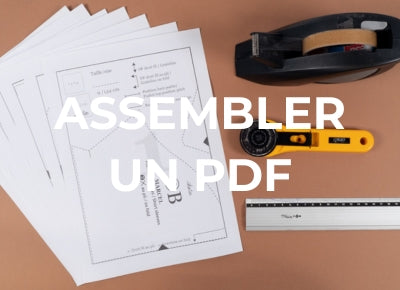
- Assembly : The PDF pattern requires printing and assembling several A4 sheets. For patterns for larger pieces, such as adult clothing or accessories, this step can be a bit tedious.
- Print quality and availability : The quality of your printer can affect the accuracy and readability of the pattern. A poorly calibrated printer can distort the cut and affect the final result. Additionally, if you don't have a printer, this complicates the process.
- Printing in A0 format : If you want to avoid collating A4 sheets, you can have your patterns printed online or at a print shop in A0 format. While this saves a lot of time, it can also add additional costs. We recommend printing all your patterns in a single order to reduce shipping costs.
All Ikatee PDF patterns come with several files:
- An A4/US Letter format containing all sizes of the model in one file.
- One A4/US Letter format per size, with a separate file for each size.
- An A0 format to be printed at a printer.
- The tutorial and the guidebook.
- A projectable format for seamstresses using the pattern projection technique.
The advantages of the paper pattern:
- Ready to Use : Paper patterns arrive ready to be copied, cut out, and used, with no printing or assembly required.
- High Quality : They are often printed on high quality paper, which makes them more durable and easy to handle.
- Simplicity : No need for additional materials like a printer or tape, and most importantly, no need to print and assemble the pattern.
The disadvantages of the paper pattern:
- Higher Cost : Paper patterns can be more expensive due to production and shipping costs.
- Reproduction : To be able to reuse your pattern over and over again, we recommend tracing the pattern to the correct size onto slightly transparent paper and then cutting it out. This allows you to preserve all the sizes of the original pattern.
- Waiting time : You have to wait for your pattern to be delivered, which may delay the start of your project.
Generally, we recommend PDF patterns for baby and toddler clothing, as the pieces are small and there's little to print. However, we recommend envelope patterns for accessories and women's clothing, as they're often more suitable for these types of projects.
This advice can obviously be adapted according to your tastes and needs!
How to use a sewing pattern?
After choosing a pattern that suits your skill level and needs, follow these steps:
Tracing a pattern involves reproducing the pattern pieces onto another medium. Here's how to do it:
- Place your pattern on a flat, stable surface.
- Attach your tracing paper to the template using tape or weights.
- Trace the outlines of the pieces with a pencil or fine-point marker. Remember to carefully note the darts, grain lines, notches, and other useful information.
- If seam allowances aren't included, add them all the way around the pattern. At Ikatee, seam allowances are included (0.7 cm for baby and children's clothing, 1 cm for women's clothing and accessories), so there's no need to add them!
- Cut out your pattern pieces and transfer them onto your fabric, taking care to mark the notches and reference points necessary for assembly. Pay attention to the straight grain, which must be parallel to the edge of the fabric!
Cut out the fabric pieces following the outlines of the pattern pieces you have transferred, respecting the grain lines and notches.
Follow the instructions included with the pattern to assemble the different fabric pieces. Take your time and follow each step carefully.
These steps aren't overly complicated, but we recommend taking your time. They're crucial to the final result of your project.
What does an Ikatee sewing pattern contain?
Our pattern boards and their dedicated tutorial booklets contain:
- General information: description of the finished garment, inspiration photos, and measurements of the finished garment.
- Guides and explanations: a size guide, instructions for adjusting the pattern to your height, detailed explanations with step-by-step diagrams, as well as fabric and supply requirements.
- Video tutorial: For most of our patterns, a video tutorial is freely available on our website. With this tutorial, we guide you step by step, showing you the different finishes and all the assembly instructions. The little extra we love? If you get stuck on a step, you can watch the video again and again to fully understand the assembly and build confidence.
- Technical details: cutting plans, grain guidelines, cutting and fold lines, seam allowances, and all important markings.
How to choose your size?
Choosing the right size is a crucial step in making your garment. Here's how to do it:
Using a tape measure, take the following measurements:
- Height/Stature: Measure from the top of your head to the soles of your feet. Remember to stand straight, looking straight ahead, and keep the tape measure vertical.
- Chest: Measure around the fullest part of your chest, keeping the tape measure parallel to the floor and loosely.
- Waist: Measure around the narrowest part of your waist, located just above your belly button.
- Hip size: Measure around the widest part of your hips.
Every sewing pattern comes with a size guide. Compare your measurements with the size guide to determine the size that best fits your body measurements. It's possible that your measurements fall between two sizes (for example, a 42 hip and a 44 waist), as size guides are created using standard retail sizes to fit as many people as possible. In this case, you can adjust the pattern's measurements to suit your specific needs.
For more information, please refer to our size guides .
Can you modify a pattern?
Yes, it is entirely possible to modify a pattern to suit your specific needs. You can adjust the length by adding or subtracting a few inches from the pattern pieces, or change the width by adjusting the side seams. You can also make broader changes to a piece or pattern feature (e.g., hip curves, sleeve shape, etc.).
However, all these modifications require a little experience: we recommend starting with small modifications before embarking on major changes!
Before cutting into your final fabric, do a first fitting on a canvas to validate the adjustments.
Why use an Ikatee sewing pattern?
- At Ikatee, we offer you complete patterns, in different formats, accessible to everyone, whatever your level and your desires. We offer patterns for babies , children , women , as well as accessories , combining timeless and trendy. You will be able to create pieces for all ages.
- For each of our patterns, we offer variations and options: by purchasing a model, you will have the opportunity to sew it several times throughout the year, without ever getting bored. You will thus obtain a varied wardrobe that meets your needs!
- We design our models for " real life ": tight, impractical and uncomfortable shapes have no place here! We test our cuts and fits on different sizes to guarantee you a comfortable and pleasant result.
- Whether you are a fan of the PDF format or prefer the paper format, you will find what you are looking for in our collection of patterns, available in both formats.
- All our patterns are made in France, in our Lyon workshop, and printed in Vendée.
- And above all, with Ikatee, you choose educational patterns , with easy-to-follow explanations , whether in video format or in the form of diagrams. You will learn to sew independently and at your own pace. Many resources are available on our site to master various sewing techniques and continue your learning in this universe.
- At the heart of our company is a passion for learning: our goal is to help you succeed and progress. With Ikatee, sewing will no longer hold any secrets for you!
Not completely convinced yet?
Sign up and receive your first Ikatee pattern for free with full instructions to discover the joy of creating your own clothes.
Feedback, an idea, a question?
You can contact us at the following address: contact@ikatee.fr .
Customer service is open Monday to Friday , 8am to 4pm , to answer all your questions. You will receive a response from us within 48 hours , excluding weekends and public holidays.